
Physiotherapy Tips for Long-Distance Drivers
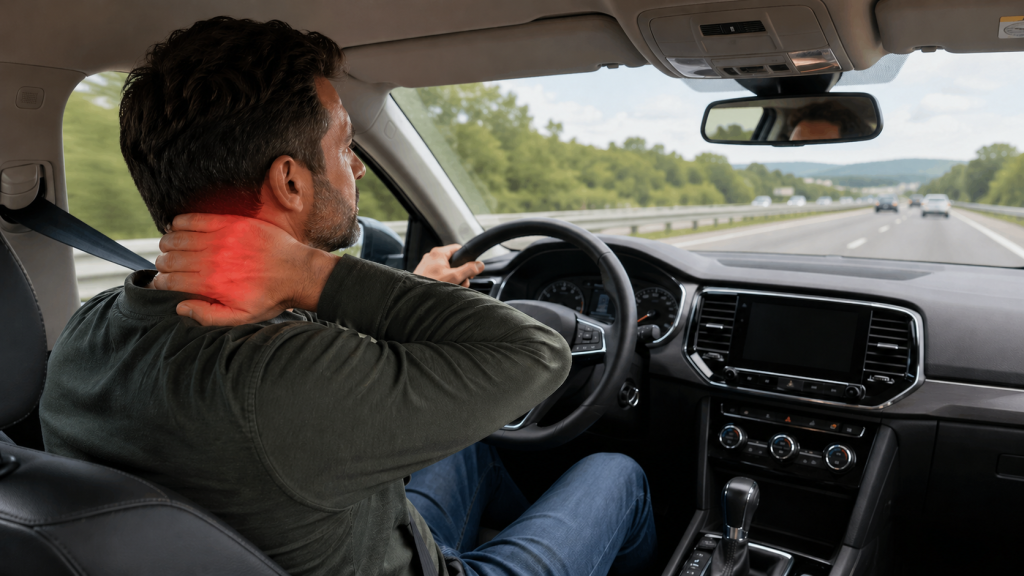
If you’ve ever done a long drive, you’ll know this feeling.
The first hour is fine. Maybe even enjoyable.
By the third or fourth hour, things begin to change.
Your lower back starts to feel tight.
The neck feels stiff when you turn your head.
Sometimes there’s a dull heaviness in the legs.
You step out of the car at a fuel stop and stretch a little… and suddenly realize how stiff the body has become.
This is something physiotherapists hear quite often from drivers. Not because driving is “bad,” but because the body is staying in one position for too long.
And the longer the distance, the more that posture starts to matter.
What Long Drives Actually Do to the Body
Driving doesn’t feel physically demanding. You’re mostly sitting, after all.
But the body is still working in a subtle way.
The lower back is supporting your posture for hours.
The shoulders stay slightly forward while holding the steering wheel.
The neck remains in a fixed position, with small repeated movements.
The legs are engaged with the pedals, often without much change in position.
Over time, these small stresses build up.
Muscles that don’t move much begin to tighten. Blood flow slows down slightly. And stiffness starts to appear.
Start With Your Sitting Position
Before thinking about exercises, it helps to look at how you’re sitting in the car.
A small adjustment here can make a big difference over long distances.
Try to sit with your back fully supported against the seat. Avoid leaning too far forward.
The seat shouldn’t be too reclined either. A slightly upright position usually works better for the spine.
Also, check the distance from the steering wheel. If you’re reaching forward, your shoulders will stay tense for the entire drive.
Bringing the seat a little closer can help the arms stay relaxed.
Give Your Lower Back Some Support
One common complaint during long drives is lower back discomfort.
Sometimes it comes from the natural curve of the spine not being supported properly.
A small cushion or a rolled towel placed behind the lower back can help maintain that curve.
It’s a simple adjustment, but many drivers notice that it reduces the tired feeling in the back during long journeys.
Don’t Wait Too Long to Take Breaks
This is one of the easiest tips to ignore.
When you’re trying to reach a destination, it’s tempting to keep going without stopping.
But the body benefits from short breaks.
Even stepping out of the car for a couple of minutes every one to two hours can help. Walk a little. Stretch your legs. Move your shoulders.
These small breaks allow the muscles to reset before stiffness builds up too much.
Simple Movements You Can Do on the Way
You don’t need a full workout during a road trip.
A few gentle movements are enough.
When you stop the car, try:
• rolling your shoulders backward a few times
• gently turning your neck side to side
• stretching your back by standing upright and reaching slightly upward
• walking around for a minute or two
These movements help improve circulation and reduce tightness.
Pay Attention to Your Neck and Shoulders
Long-distance drivers often complain about neck stiffness.
This usually happens because the neck stays in a fixed position for too long, especially when focusing on the road.
Make sure your headrest is positioned correctly. It should support the back of your head without pushing it forward.
Keeping your shoulders relaxed while driving also helps reduce unnecessary tension.
Sometimes people grip the steering wheel too tightly without realizing it.
Foot and Leg Position Matters Too
The legs don’t move much during driving, especially on long highways.
This can sometimes lead to stiffness or a heavy feeling in the legs.
Whenever you take a break, try to walk a little and move your ankles.
Simple movements like rotating your ankles or gently stretching the calves can help keep circulation active.
A Few Small Habits That Add Up
None of these tips are complicated.
Adjust your seat.
Support your lower back.
Take short breaks.
Move a little whenever you can.
Individually, they may seem small. But together, they can make a long drive feel much more comfortable.
Driving Comfortably Is Also About Taking Care of Your Body
Long-distance driving is often part of work, travel, or daily life for many people.
You may not always be able to avoid sitting for long hours.
But you can make it easier on your body.
A few small changes in posture and a little movement along the way can reduce stiffness and help you feel better once the journey is over.
And sometimes, that’s all it takes to make the drive a lot more comfortable.
If driving has left you with back pain, see how to relieve lower back pain without surgery, or visit the best physiotherapist in Sector 51 Gurugram.