
Kinesiology Taping
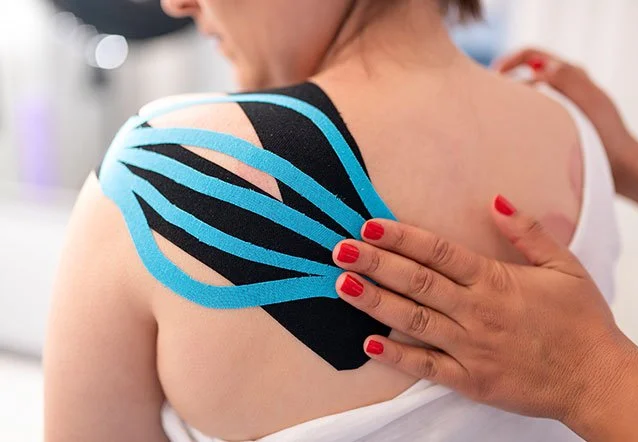
Kinesiology taping is a rehabilitation technique that supports the body’s natural healing process while keeping joints and muscles free to move. Instead of limiting motion, the tape provides gentle support and stability. As a result, patients stay active during recovery.
Moreover, physiotherapists use kinesiology taping to adjust muscle tone, improve posture, guide movement patterns, and help lymphatic fluid flow. The therapist applies elastic therapeutic tape in specific directions on the body. Consequently, patients often feel less pain, reduced swelling, and better function.
Furthermore, kinesiology taping works best when combined with other physiotherapy treatments. At Dr. Manoj Rajour’s clinic, patients receive personalized taping plans based on their condition and activity level. Therefore, many people see faster recovery and improved daily movement.
Conditions commonly supported with Kinesiology Taping
- Pain and swelling in the neck, shoulder, elbow, wrist, lower back, hip, groin, or knee
- Shoulder instability and injuries
- Tennis elbow
- Hamstring and quadriceps strain
- Plantar fasciitis
- Ankle instability and turf toe
- Tibialis posterior dysfunction
- Bunions
- Patellofemoral stress syndrome
Overall, kinesiology taping improves comfort, supports weak zones, and helps patients move with confidence.
Manual Therapy

Manual therapy is a hands-on physiotherapy technique. Physiotherapists use skilled movements to assess joints and soft tissues and then treat pain and stiffness. As a result, patients gain better movement and faster relief.
In addition, manual therapy improves tissue flexibility, increases range of motion, relaxes tight muscles, and restores healthy movement patterns. At the same time, it reduces pain, swelling, and inflammation. Therefore, many patients notice immediate comfort after sessions.
Moreover, manual therapy helps mobilize joints and release tight muscles. Consequently, it plays an important role in recovery after injury or surgery.
Conditions commonly treated with Manual Therapy
- Neck pain: post-surgical pain, muscle spasm, disc problems, rib stiffness
- Hip pain: myofascial pain, hip impingement, bursitis, post-surgical hip issues
- Ankle pain: chronic ankle pain, sprains, post-surgical pain, arthritis
- Lower back pain: post-surgical pain, disc problems, spinal stenosis
- Elbow pain: tennis elbow, golfer’s elbow
- Knee pain: total knee replacement recovery, IT band issues
- Shoulder pain: impingement, frozen shoulder, rotator cuff problems, post-surgical pain
- Thoracic or mid-back pain
- Headaches and migraines
- Muscle trigger points
- Temporomandibular joint dysfunction (TMJ)
- Wrist pain
Ultimately, manual therapy restores movement, eases pain, and helps patients return to daily activities with greater comfort.