
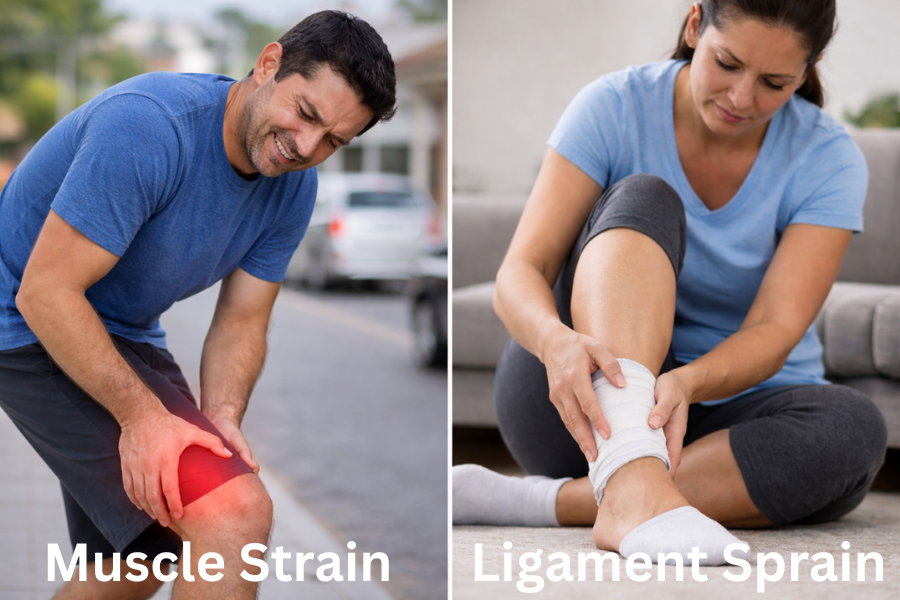
People usually don’t come to us saying, “I have a ligament sprain.”
They come in and say, “Something is wrong. It hurts.”
And then the question comes up — is it a strain or a sprain?
Most people assume they’re the same thing. Even many gym-goers and regular runners mix them up. The confusion is understandable because both happen suddenly, both hurt, and both make movement difficult.
But inside the body, they are not the same injury.
A muscle strain is related to the muscle itself. It usually happens when the muscle is stretched more than it’s ready for. Sometimes it’s during exercise. Sometimes it’s during something very normal, like bending, lifting, or turning quickly. I’ve seen people strain muscles just by getting up awkwardly from a chair.
With muscle strains, the pain often feels deep and sore. Patients say things like “it feels tight” or “it’s pulling when I move.” Touching the muscle feels uncomfortable. Stretching usually makes it worse. The movement is there, but it doesn’t feel free or relaxed.
Ligament sprains are different. Ligaments hold joints together. They don’t help you move — they help keep things stable. When a joint twists suddenly, the ligament takes the load. If that load is too much, the ligament stretches or tears.
That’s why sprains are mostly joint injuries. Ankles, knees, wrists — these are the usual suspects.
With sprains, people often remember the exact moment it happened. A misstep. A slip. A wrong landing. Swelling tends to come early. The joint may feel weak or unreliable. Some people say, “I don’t trust it.”
One simple way I explain it in the clinic is this:
If it feels like the pain is coming from the flesh, it’s likely a strain.
If it feels like the pain is coming from the joint, it’s likely a sprain.
Problems start when people treat both injuries the same way.
Some people rest completely for weeks after a sprain and end up with stiffness and poor balance. Others keep pushing through a muscle strain because “it’s just muscle pain,” and then wonder why it keeps coming back.
Neither approach works well.
This is why assessment matters. Not Google. Not guessing. Not comparing symptoms with a friend.
In physiotherapy, we look at how the area moves, how strong it is, how stable it feels, and what the rest of the body is doing to compensate. Pain alone doesn’t tell the full story.
Recovery also looks different. Muscles usually need controlled movement and gradual strengthening. Ligaments need stability, balance work, and time under the right kind of load.
One thing I always tell patients — if pain is hanging around, swelling isn’t settling, or movement doesn’t feel confident after a few days, don’t ignore it. Small injuries become long problems when they’re left alone.
Strains and sprains are common, but they’re not “nothing injuries.” Treated properly, they heal well. Treated casually, they tend to return.
If you’re unsure what you’ve injured, that’s normal. Most people are. That’s where professional guidance helps — not just to reduce pain, but to make sure the problem doesn’t come back again.