
Chronic pain is rarely dramatic.
It usually starts small — a heel that hurts in the morning, a shoulder that aches after work, or an elbow pain that never completely goes away. Over time, people adjust. They walk differently. They avoid movements. They live with it.
Most patients who come to Matteo Physio tell us the same thing:
“Painkillers help for a few days, but the pain always returns.”
This is exactly where shockwave therapy becomes useful.
What shockwave therapy actually is (in simple terms)
Shockwave therapy is not surgery.
There are no injections.
No medicines are given.
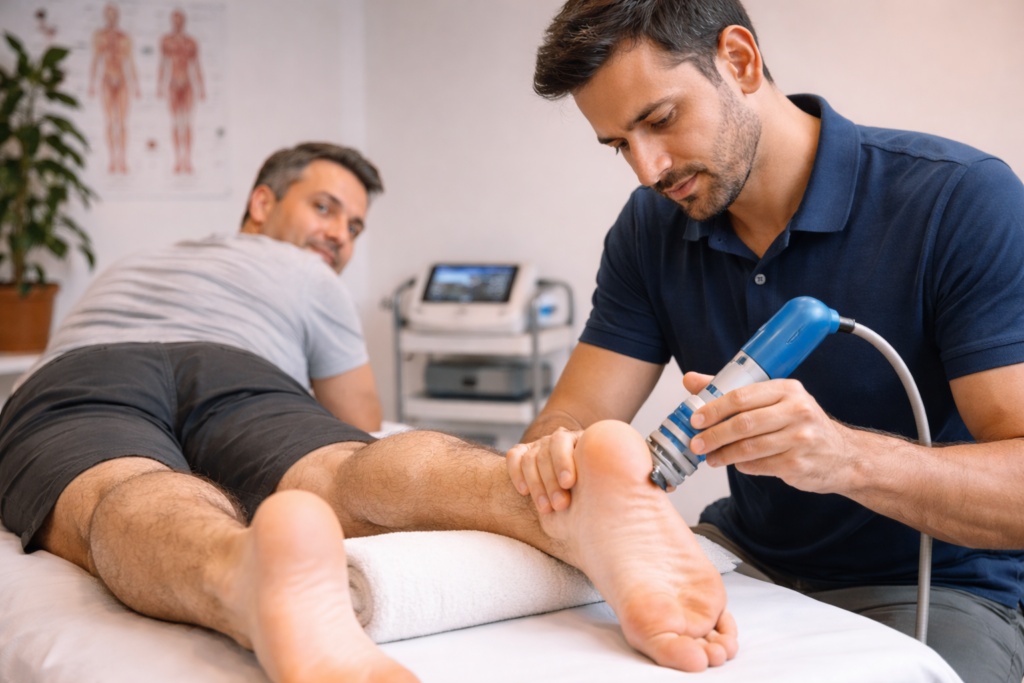
It uses controlled sound waves that are applied directly to the painful area using a handheld device. These sound waves travel into the tissue and stimulate healing where the body has slowed down or stopped repairing itself.
In chronic pain, healing often gets “stuck.” Shockwave therapy helps restart that process.
Why chronic pain is different from normal pain
Acute pain usually heals with rest.
Chronic pain doesn’t.
When pain lasts for months, the tissue often has:
- poor blood circulation
- tight or damaged fibres
- small areas that never healed properly
This is why exercises alone or painkillers alone may not work.
Shockwave therapy works deeper than surface treatments. It improves circulation and encourages tissue repair instead of just reducing symptoms.
Conditions where we commonly use shockwave therapy
In day-to-day clinical practice, shockwave therapy is most useful for:
- Knee tendon pain
- Knee tendon pain
- Shoulder tendon pain
- Achilles tendon pain
- Knee tendon pain
- Hip and gluteal pain
- Long-standing muscle trigger points
It is especially helpful when pain has been present for more than 3 months.
What a session feels like
A shockwave therapy session is short.
After assessment, a gel is applied to the area and the device is placed over the painful spot. You may feel discomfort — especially during the first session — but it is usually tolerable.
Most sessions last 10 to 15 minutes.
Pain often feels different after treatment. Some patients feel lighter movement, others feel mild soreness for a day. Both are normal responses.
How many sessions are needed?
There is no fixed number for everyone.
Most patients need 3 to 6 sessions, depending on:
- the severity of pain
- how long the pain has been present
- activity level and recovery response
Shockwave therapy works best when combined with proper physiotherapy exercises and movement correction.
Is shockwave therapy safe?
Yes, when used correctly by trained physiotherapists.
Side effects are usually mild and temporary, such as:
- slight soreness
- redness
- sensitivity for a short period
Before starting, a proper assessment is always necessary to rule out conditions where shockwave therapy should be avoided.
Why we don’t use shockwave therapy alone
At Matteo Physio, shockwave therapy is never treated as a magic solution.
Pain relief without correcting movement patterns often leads to recurrence. That’s why shockwave therapy is combined with:
- rehabilitation exercises
- mobility work
- posture and load correction
The goal is not just pain reduction — it is long-term recovery.
Final Thoughts
Shockwave therapy is not for everyone.
But for chronic pain that refuses to improve, it can be a turning point.
If pain has been limiting your movement, affecting your routine, or constantly returning despite treatment, shockwave therapy may be worth considering after a professional evaluation.
Sometimes, the body just needs the right stimulus to heal again.